

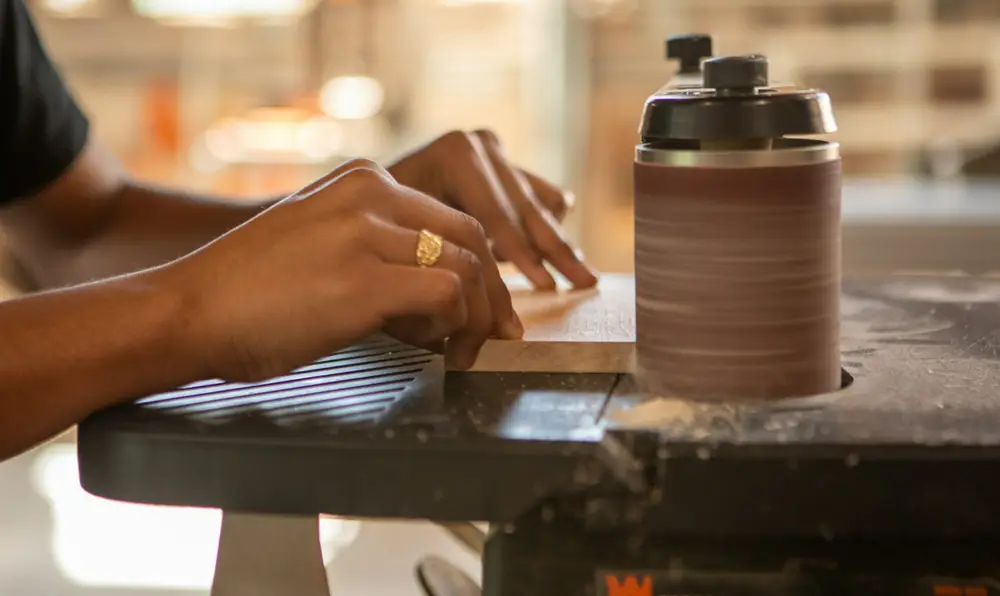
Sanding is a crucial steps in prepping wooden surfaces before applying paints or oils. Many craftspeople thinks that sanding are just about making a surface feel soft to the hand. But in reality sanding are a controlled process of scratching a material with sharp mineral grains. The primary golden rule of sanding state that you must never skip more than one grit level in your sequence.
The Fundamental Golden Rule of Sanding
When you works through your sanding passes, every coarse grit creates deep valleys on the surfaces. A finer grit that comes next exist specifically to grind down those deep valleys until they is replaced by smaller ones. If a person skip from a very coarse grit like 80 straight to a fine 220 grit, the fine grains is too small to remove the deep gouges. You ends up with shiny surfaces that still shows deep scratch marks under a clear stain.
The golden rule are also known by many tradespeople as the 50 percent rule or the rule of doubling. This means the next grit number in your sequence should never be more than roughly 50 percent higher than previous grit. For instances, going from 80 grit to 120 grit is acceptable because you only skips the 100 grit. But jumping from 80 grit straight to 180 grit violate the rule and cause major finish failures.
The Science Behind Scratches and Grit Progressions
Every pieces of sandpaper contains thousands of tiny abrasive points glued onto a paper or cloth backings. These tiny points acts like miniature chisels that carves thousands of uniform grooves into the wood fibers. Sandpaper grit sizes is measured by the number of mesh openings per linear inch in a sizing sieve. Lower numbers represents coarse particles while higher numbers represents very fine particles.
A standard progression for raw hard woods typically starts at 80 or 100 grit depending on how rough the board are. The craftsman then move to 120 grit, followed by 150 grit, and finishes at 180 or 220 grit for most furniture projects. Skipping steps in this progression leaves behind deep scratches that remain hidden until you applies liquid finishes. Once a stain or polyurethane hit the raw wood, those hidden scratches absorbs extra pigment and turns into dark unsightly lines.
To track your progress properly, seasoned workers often uses the simple pencil mark trick. You lightly draws zig-zag pencil lines across the entire wood board before starting with a new grit. As you sands the surface, the pencil lines acts as visual indicators. When all the pencil marks disappears completely, you knows that the previous scratch patterns is fully erased and you can safely advances to the next higher grit.
Grain Alignment and Pressure Techniques
Beside progressive grit sequencing, a secondary golden rule of sanding requires that you always sands parallel to the natural wood grain. Wood fibers grows like bundle of thin straws running along the length of a board. When you sands across this grain direction, the sharp abrasive grains cuts across the fibers and creates deep cross-grain scratches. These cross scratches is extremely difficult to remove once they forms.
Applying the correct amount of downward pressure is also critical for getting good result. Many beginners makes the mistake of pushing down heavily on an orbital sander to speed up the work. However, excessive pressure actually slows down the motor and causes the sander to leave tiny swirl marks known as pigtails. The weight of the machine itself plus light hand pressure is all that are needed for effective sanding action.
Letting the abrasive paper do the actual work keeps the motor cool and prevent early clogging of the sanding disc. When wood dust builds up between abrasive grains, a condition called loading occur. Loaded sandpaper produces excessive heat which can burn the wood fibers and ruin the surface smooths. Cleaning your sanding pads regularly with a rubber cleaning stick extends the life of your abrasives significantly.
Market Statistics and Technical Grit Standards
The global market for coated abrasives is a massive industry that support woodworking and manufacturing worldwide. Recent research reports indicates that the global coated abrasives market was valued at approximately 15.2 billion dollars in 2025. This market is projected to reach over 20 billion dollars by 2034, growing at a steady annual rate of around 3.19 percent. Aluminum oxide remains the most widely used abrasive material, holding over 40 percent of total market share due to its durability on hard woods.
Woodworking applications accounts for a substantial portion of total abrasive consumption globally. In industrial production lines, sanding accounts for nearly 25 to 30 percent of total labor hours during furniture manufacturing. Using improper grit sequences leads to expensive re-work, which can increases production costs by as much as 15 percent.
There is two major standards used to measure sandpaper grit sizes globally. The CAMI standard are widely used in North America, while the FEPA standard is standard across Europe and identified by the letter P before the number. A 220 grit paper under CAMI standard are slightly different in particle size compared to a P220 paper under FEPA. Understanding this distinction help woodworkers avoid accidentally jumping across incompatible grit sizes when switching between different sandpaper brands.
