

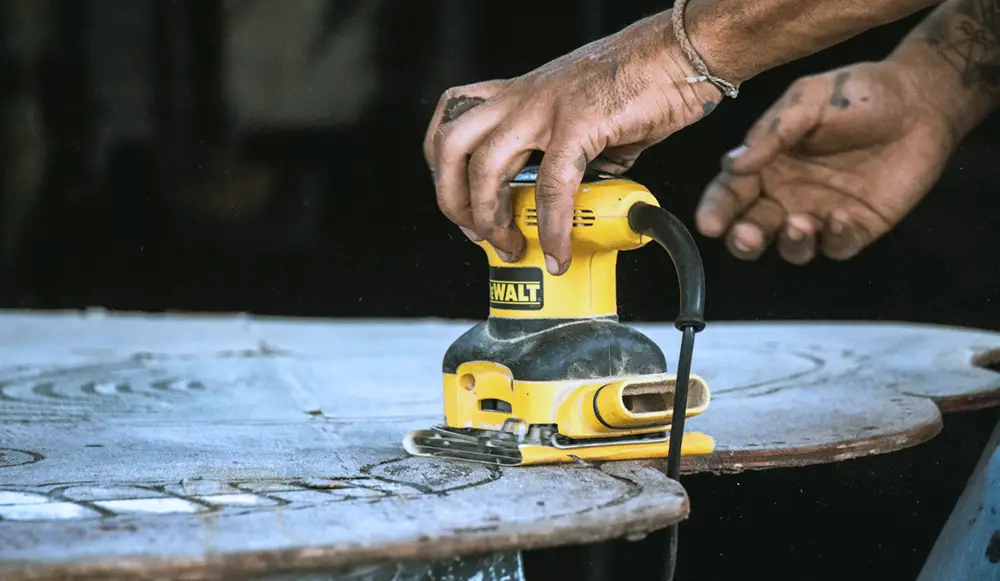
Power sanders come in several styles and two of the most common ones people mix up are the orbital sander and the random orbital sander. Both tools smooth wood metal and other surfaces but they work in different ways and that change shows up in the results you get. Many shops keep both kinds because each fills a role the other cannot match as well.
Basic Working Action of Each Tool
An orbital sander moves its sanding pad in small tight circles that stay the same size and path. The pad itself does not spin freely on its center. Instead the whole pad vibrates in a fixed orbital pattern. Most models use a square or rectangular pad that holds a piece of regular sandpaper sheet usually cut to one quarter of a standard 9 by 11 inch sheet. That is why people also call them quarter sheet sanders or finishing sanders. Half sheet versions exist too for larger flat work.
A random orbital sander takes that idea further. Its round pad spins while at the same time the center of the pad moves in a small eccentric orbit. The combination means no single grain of abrasive follows the same path twice in a row. The result is a more random scratch pattern. Most of these tools take 5 inch or 6 inch diameter discs that attach with a hook and loop system. Some older models used sticky backed discs but the loop style is common now.
The random orbital design first reached commercial markets in 1968. Before that most powered finish sanders used the simpler fixed orbit motion. The added spin made a clear improvement in how marks showed under stain or clear finish.
Pad Shape and What That Means for Access
The square pad on a standard orbital sander gives it a real edge when you need to work into corners or along edges. You can press the side of the pad right up against a baseboard or into the corner of a drawer box. Round pads on random orbital models leave a small gap and you usually finish those spots by hand or with a detail sander.
On the other hand the round pad covers a continuous surface without sharp corners of its own. For large flat panels table tops or cabinet sides that shape works well and the random motion helps keep the surface even.
Material Removal Rate and Finish Quality
When both tools run the same grit paper the random orbital sander removes stock faster. The dual motion cuts more aggressively while still spreading the scratches so they do not form clear swirls. Tests with 100 grit paper often show the random orbital taking off more material in the same time. That speed helps on rough lumber or when stripping old finish.
The plain orbital sander works more gently. It is harder to dig a hollow or remove too much wood by accident. That control suits final smoothing before paint or light touch up work. The trade off is slower progress on larger jobs.
Swirl marks remain a concern with either tool if you press too hard or move too fast. On a fixed orbit model the repeating circles can leave faint patterns that show under high gloss finishes especially on soft woods like pine. The random version reduces that risk because the path keeps changing yet it can still leave small pigtail scratches if the disc spins too slowly under heavy pressure or if the backing pad is worn.
Dust Collection and Everyday Handling
Many random orbital sanders include holes in the pad and disc so a vacuum or dust bag can pull debris away while you work. That feature helps keep the paper from loading up and cuts down on airborne dust. Some orbital sheet sanders also offer dust ports but the square pad design makes the hole pattern less efficient in many cases.
Both tools stay light enough for one handed use on most models. Corded units usually draw between 2 and 3 amps. Cordless versions have grown popular for jobs away from outlets. Vibration levels vary by brand yet the random orbital tends to feel a bit smoother once the pad reaches full speed.
Cost and Paper Options
Entry level orbital sanders often sell for less than random orbital models of similar quality. You can find basic quarter sheet tools starting near the low end of the price range while mid range random orbital units sit a step higher. Industrial versions of either type cost more.
Paper cost differs too. Regular sandpaper sheets cut to fit an orbital sander cost less per use than the pre punched discs made for random orbital tools. Many people keep a stock of both so they can choose by the job.
When Each Tool Fits Best
Use a standard orbital sander when the work involves tight corners edges or light final passes. It shines on furniture details window frames and places where a round pad cannot reach. The tool also suits beginners who want less chance of removing too much material.
Reach for a random orbital sander when you face larger surfaces or need faster stock removal without heavy swirl risk. Cabinet faces doors tabletops and general furniture prep all benefit from the random action. Most professional woodworkers and auto body shops treat it as the main finish sander for open areas.
Many shops end up owning one of each. The random orbital handles the bulk of the work while the sheet style orbital cleans up the spots the round pad misses.
Market Trends and Common Specs
In recent years random orbital models have taken a large share of the finish sander category in many regions. One overview of the broader orbital sander group showed random orbital units accounting for well over half the value in some recent yearly data. Sheet style orbital sanders held a smaller but steady portion because of their corner ability and lower cost.
Typical random orbital pads measure 5 inches across and contact roughly twenty square inches of surface at once. Orbit diameters often fall between 2.5 mm and 5 mm. Smaller orbits favor finer finishes while larger ones cut faster. Speeds commonly range from several thousand orbits per minute upward depending on the motor and load.
These numbers help explain why the random design spread so widely after its introduction. The extra motion solved a long standing problem with visible scratch patterns while still keeping the tool compact and easy to control.
Practical Tips for Better Results
Whatever tool you choose keep the paper clean and change it before it loads with dust. Move the sander slowly about one inch per second and let the weight of the tool do most of the work. Jumping grits too far leaves deeper scratches that later steps cannot erase easily. A common sequence runs from 80 or 100 grit through 150 and then 220 for most furniture surfaces.
Check the backing pad on random orbital models from time to time. A worn pad can wobble and create extra marks. On sheet sanders make sure the clamps hold the paper tight so it does not slip and tear.
Both tools last longer when you empty the dust system regularly and avoid pressing hard enough to stall the motor.
Choosing Between Them for Your Shop
If your projects stay small and involve lots of inside corners a basic orbital sander may cover most needs at lower cost. For mixed work that includes large panels and the need for a clean random scratch pattern the random orbital sander usually proves more useful as a primary tool. Many people start with the random orbital and add a sheet style later for the details.
Understanding the motion of each pad the shape of the abrasive and the way scratches form lets you pick the right one for the surface in front of you. That choice saves time and produces a cleaner result ready for finish.
